The Uncomfortable Stat Nobody's Putting in Their Deck
We surveyed over 300 marketers. Only 48% of them have a clear, well-documented Ideal Customer Profile.
That means roughly half the marketing teams operating right now are spending real budget, real time, and real headcount talking to... someone. They're not sure who. They just keep making stuff and hoping it lands.
That's not a marketing problem. That's a business problem.
Every downstream decision in your marketing strategy, the channels you invest in, the content you produce, the tone of your copy, the keywords you target, the campaigns you run, all of it flows from one foundational question: who are we actually talking to?
If you can't answer that question specifically, you can't answer any of the others well either. You're building a house without a blueprint and wondering why the rooms are weird.
Okay, So What Actually Is an ICP?
ICP stands for Ideal Customer Profile. It's the documented description of the type of company and buyer you are best positioned to serve, most likely to close, and most likely to retain.
Notice: "type of company and buyer," not "anyone who might be interested." That distinction matters.
An ICP isn't a wish list. It's a filter. It's how you get focused enough to actually be good at reaching someone instead of mediocre at reaching everyone.
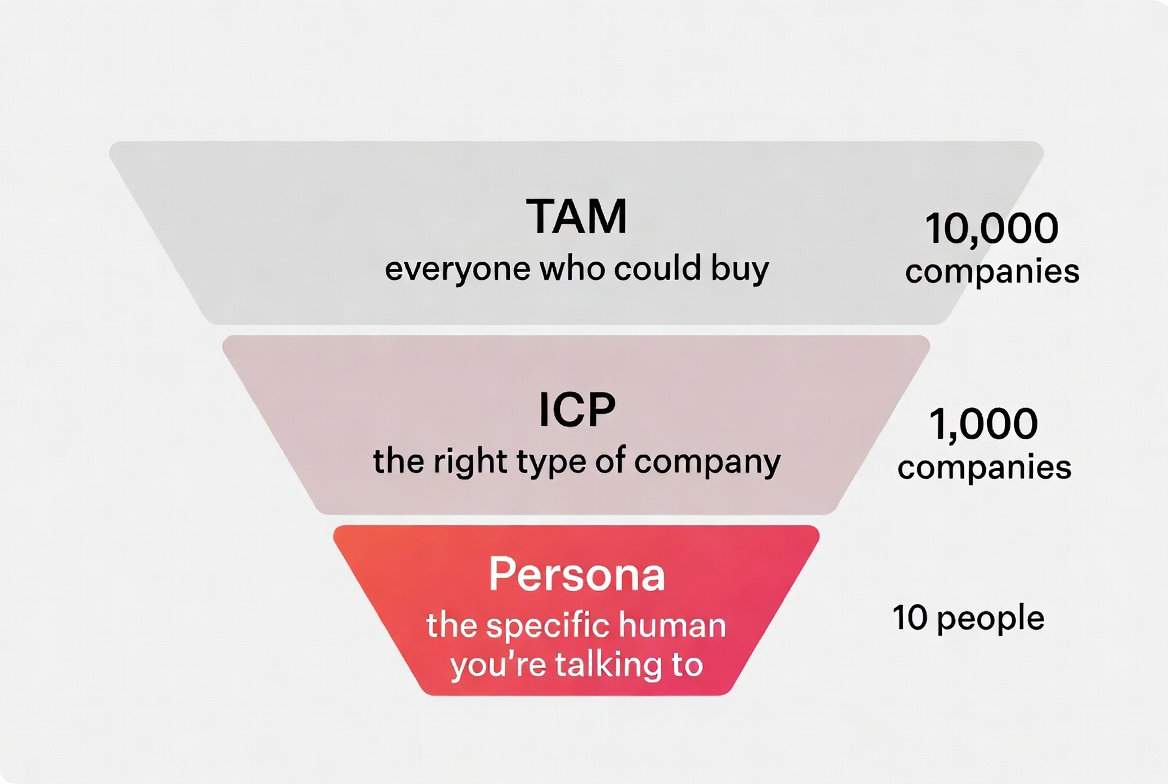
And here's where most teams get tripped up: ICP, persona, and TAM are not the same thing. They live at different levels of your targeting strategy and serve different purposes.
TAM vs. ICP vs. Persona: The Funnel Nobody Drew You
Think of these three terms as zoom levels on a map.
TAM (Total Addressable Market) is the widest view. This is every single company or person on earth who could theoretically buy what you sell. If you sell marketing software, your TAM is every business that runs marketing. It's a massive number and mostly useful for investor decks and strategic planning conversations.
ICP is where you zoom in to street level. Out of that massive market, which segment of companies is actually the right fit for your product right now? Where do you have the most revenue potential? Where do your best customers already come from?
A tight ICP looks like: "We're targeting mid-market SaaS companies with 50 to 500 employees, primarily in the northeast United States, where the head of marketing is the primary decision maker." That level of specificity is the whole point.
Persona is the most zoomed-in layer. Once you know the type of company you're going after, who exactly inside that company are you talking to? Because even within one target company, the director of marketing, the head of IT, and the head of sales all have different jobs, different priorities, different pain points, and different vocabulary.
The persona is the individual human. The ICP is the company they work at. TAM is the ocean they're swimming in.
Why this matters in practice: If you're selling marketing software, you might be selling to a buying committee. The CMO signs off, the director of marketing spec'd it out, and IT security reviews the contract. Those three people need completely different messaging. Lumping them into one "audience" is why so much B2B content feels like it was written for no one in particular.
What a Good ICP Actually Contains
Building an ICP isn't just "we target marketing directors at mid-size companies." That's a starting point, not a finished document. A real ICP contains both firmographic data and qualitative insight.
Firmographic data is the objective, measurable stuff:
- Industry or vertical
- Company size by headcount or revenue
- Geographic location
- Business model (B2B vs. B2C, recurring revenue vs. transactional)
- Tech stack (if relevant to your solution)
- Funding stage or growth trajectory
This is the information that tells you which companies to put on a list. Most of it lives in your CRM already, or you can pull it from LinkedIn.
Qualitative insight is what actually makes the ICP useful:
- What pain points are you hearing on sales calls and support tickets?
- What language do your best customers use when they describe their problems?
- What were they trying before they found you?
- What made them finally decide to buy?
- What almost made them not buy?
This is the information that tells you what to say when you get in front of those companies. It's the difference between copy that technically describes your product and copy that makes someone feel like you read their diary.
Where to Go Get That Data (Without a Team of 50)
The good news: you do not need a massive research budget or a six-month process to build a workable ICP. Here's the actual playbook.
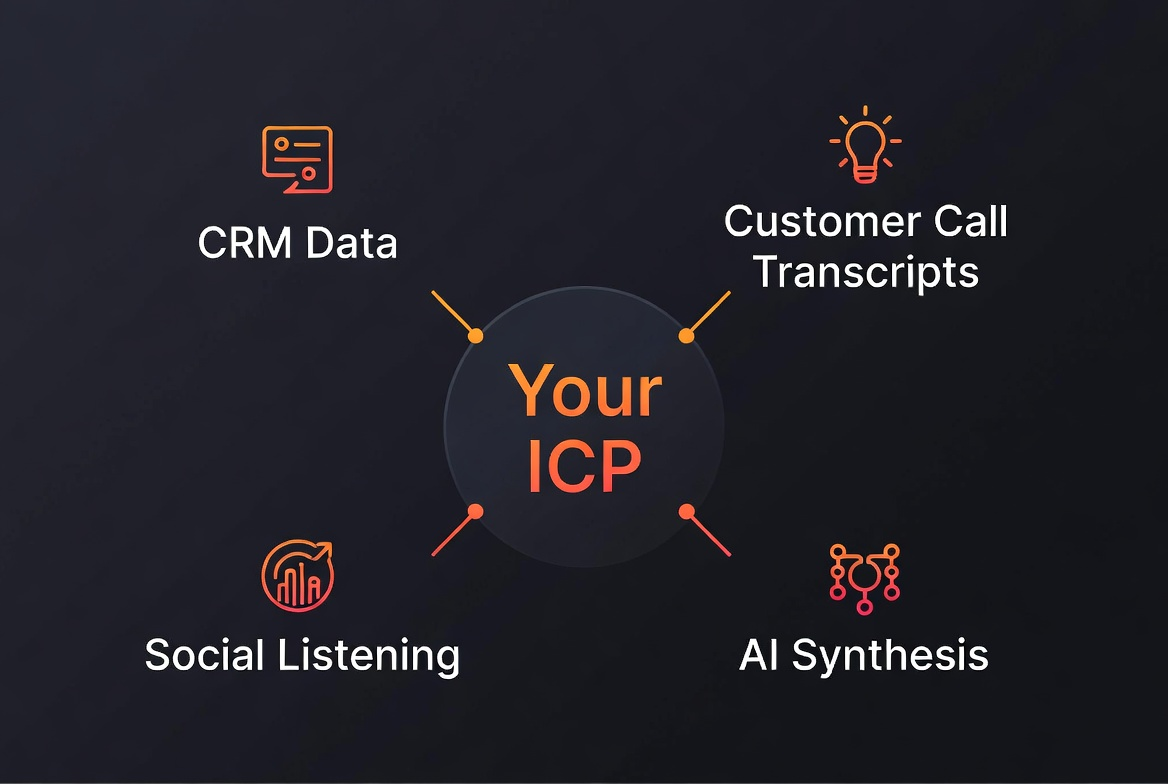
Start with what you already have. Pull your CRM data. Look at your best customers, not just your biggest ones, but the ones who renew, refer others, and require the least hand-holding. What do they have in common? Industry, company size, geography, team structure? Those commonalities are the early skeleton of your ICP.
Then talk to people. Five customer calls. That's it for a first pass. Thirty minutes each. Ask them what their day-to-day looked like before they found you, what they were trying to solve, and what almost stopped them from signing up. Customers genuinely want to tell you this stuff. They're not doing you a favor; they're sharing because they care about seeing the product get better.
Record the calls (with permission) and get them transcribed. AI tools handle this easily now. Once you have those transcripts, you have something more valuable than any survey: the actual words your customers use to describe their own problems.
Layer in social listening. Check Reddit threads in your industry. LinkedIn comments and posts from your target personas. What are people complaining about? What questions keep coming up? What tools are they comparing? This is unfiltered market research that doesn't cost anything except a few hours of reading.
Use AI to synthesize it all. This is where it gets genuinely powerful. Take those five call transcripts, your CRM export, and your social listening notes. Drop all of it into an LLM like Claude or ChatGPT with a prompt like: "Based on this data, define an ICP for my business. Include common firmographic traits, recurring pain points, and the language my customers use to describe their problems."
What would take a team weeks of analysis takes the model about forty-five seconds. You still review and refine it and the AI is synthesizing your inputs, not inventing truth, but it compresses the heavy lifting dramatically.
Growth Gabby: What a Real, Usable Persona Looks Like
HubSpot's primary marketing persona has a name: Growth Gabby. And yes, she has a whole personality.
Gabby is a marketing executive, typically a director or VP, at a growing company. She's AI-forward, experimental, constantly juggling more work than her headcount can handle, and she is not interested in your 101-level content. She's set up Facebook pages. She's run ad campaigns. She's generating pipeline. She wants the 301-level insight, the thing she hasn't thought of yet, the framework she can take into her next leadership meeting.
When HubSpot's content team is deciding what to cover and at what depth, they ask: would Gabby find this useful, or would Gabby be bored? That question kills a lot of mediocre content ideas before they ever get written.
The former HubSpot CEO Brian Halligan used to bring a teddy bear to meetings, physically named after their persona. When a business decision came up, he'd turn to the bear and ask what it thought. Cheesy? Absolutely. Effective at keeping the customer front and center? Also absolutely. The persona isn't a document you file away. It's a decision-making filter you use constantly.
The Real ROI: What Happens When Your Whole Team Actually Uses It
An ICP or persona is only worth building if people actually use it. And "using it" doesn't mean forwarding a PDF around in Slack once a year.
The teams that get the most out of their ICP work are the ones that make the persona part of daily operating rhythm. That looks like:
Marketers checking new campaign concepts against the ICP before they build anything. Sales reps using the persona to qualify leads faster and personalize their outreach. Customer success teams using it to set the right expectations from day one. Leadership using it to gut-check product roadmap decisions.
When every team is aligned on who you're serving and what that person cares about, you stop having the conversation where marketing blames sales for not closing the leads they're sending, and sales blames marketing for sending the wrong people. The ICP is the shared operating agreement.
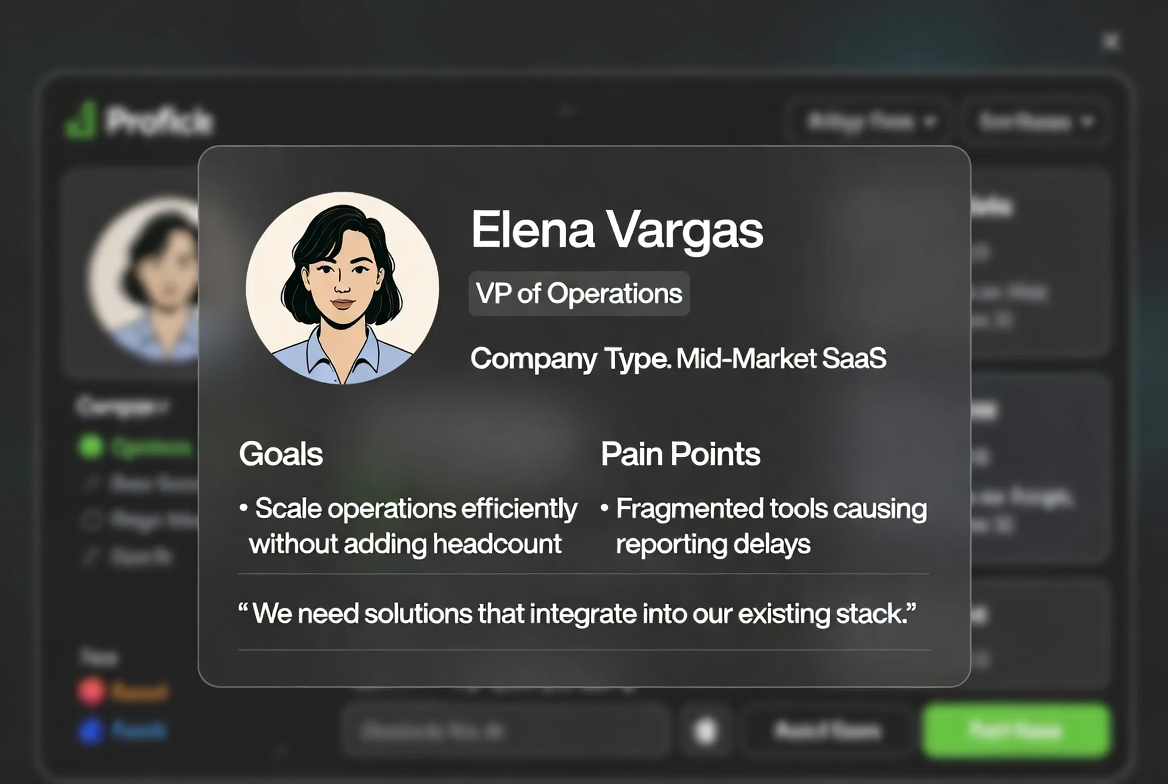
Some tools make this easier by letting you save the persona directly in the platform, so every time someone's publishing content or building an ad, there's an automatic gut-check built into the workflow. That kind of structural consistency is worth more than any one-time alignment meeting.
And if you want to get really serious about it, load your ICP into an LLM project. Feed in your persona details, your product information, your pricing, your key differentiators, all of it. Then your team can have live conversations with it: "Would Gabby care about this campaign angle?" "How should I position this feature for a director-level buyer?" "Does this email subject line match how our ICP actually talks?"
That's not a future-state fantasy. Teams are doing it right now. And it's the difference between an ICP that lives in a doc nobody opens and one that actively shapes decisions every single day.
The Cost of Skipping This Work
Here's the version of this nobody likes to say out loud: if you don't have a clear ICP, you're not just leaving performance on the table. You're actively wasting money.
Every piece of content written for the wrong audience is budget down the drain. Every ad served to someone who was never going to buy is money gone. Every sales rep wasting time on leads who were never a good fit is quota they could've been closing somewhere else.
The ICP work feels like overhead. It feels like you're delaying the "real" work of making campaigns and generating leads. But it's actually the precondition for the real work being worth anything.
Half the marketing teams in the world skipped this step. The other half are beating them.
Start Here: Your ICP in a Week
You don't need a quarter to do this. Here's a one-week version:
Day 1: Pull your CRM data. Identify your top ten customers by some combination of revenue, retention, and ease of relationship. Note their industry, size, location, and primary contact job title.
Days 2 to 4: Schedule five 30-minute calls with customers from that list. Record with permission and get transcripts.
Day 5: Feed the transcripts and your CRM data into an LLM. Prompt it to identify common firmographic traits, recurring pain points, and the language customers use. Review and refine the output.
Day 6: Add your product info, pricing, and key differentiators to the same LLM project. Now you have a working AI-powered ICP your team can actually query.
Day 7: Share it with marketing, sales, and customer success. This is not the finished version. There's no finished version. It's a living document that gets sharper the more data you feed it.
One week. Five calls. An LLM. That's all it takes to go from flying blind to flying with a map.
Conclusion
Half your competitors are guessing. They're making content for nobody in particular, running ads to audiences they couldn't describe in a meeting, and wondering why their conversion rates look like that.
The ICP is the unglamorous foundational work that makes everything else work. It's not the fun part of marketing. It doesn't feel creative. But it's the thing that makes all the creative work land.
Build the profile. Give it a name. Bring it to the meeting. Ask it what it thinks.
You'll make better decisions every single time.
FAQ
What's the difference between an ICP and a buyer persona? An ICP describes the company you're targeting: industry, size, location, business model, buying committee structure. A persona describes the individual within that company their job, daily challenges, goals, and how they make decisions. You need both. The ICP tells you which door to knock on. The persona tells you what to say when someone answers.
Do I need a CRM to build an ICP? No. A CRM helps, but it's not required to start. You can build an early ICP using five customer conversations, LinkedIn research on your target market, Reddit and community listening, and an LLM to synthesize your findings. Start with what you have and build from there.
How often should I update my ICP? Treat it as a living document. Review it at minimum once a year, or any time your product, pricing, or target market meaningfully changes. The companies that stay sharpest on ICP are the ones that keep feeding it new data from sales calls, customer conversations, and campaign performance.
Can I use AI to build my ICP from scratch? AI is a powerful synthesis tool, not a research substitute. Use it to analyze data you've already collected — call transcripts, CRM exports, survey results, social listening. Asking an LLM to just "give you an ICP" with no underlying customer data will give you a generic answer that sounds plausible and fits no one in particular.