SEO in 2026: A Guide Written by Someone Who Actually Started Post-AI
For most people, learning the basics of SEO is genuinely difficult. A lot of the tactics being taught today were developed before AI became part of everyday life. What makes this guide different is that it was written by someone who started learning SEO techniques post-AI. So you're getting the latest tools and workflows I actually use myself.
We're in 2026 and WordPress is still the king of blogs, but there are new players in the roster. Platforms like Wix, Squarespace, and even pages coded in straight HTML are flooding the internet every second.
Getting Started with WordPress SEO Plugins
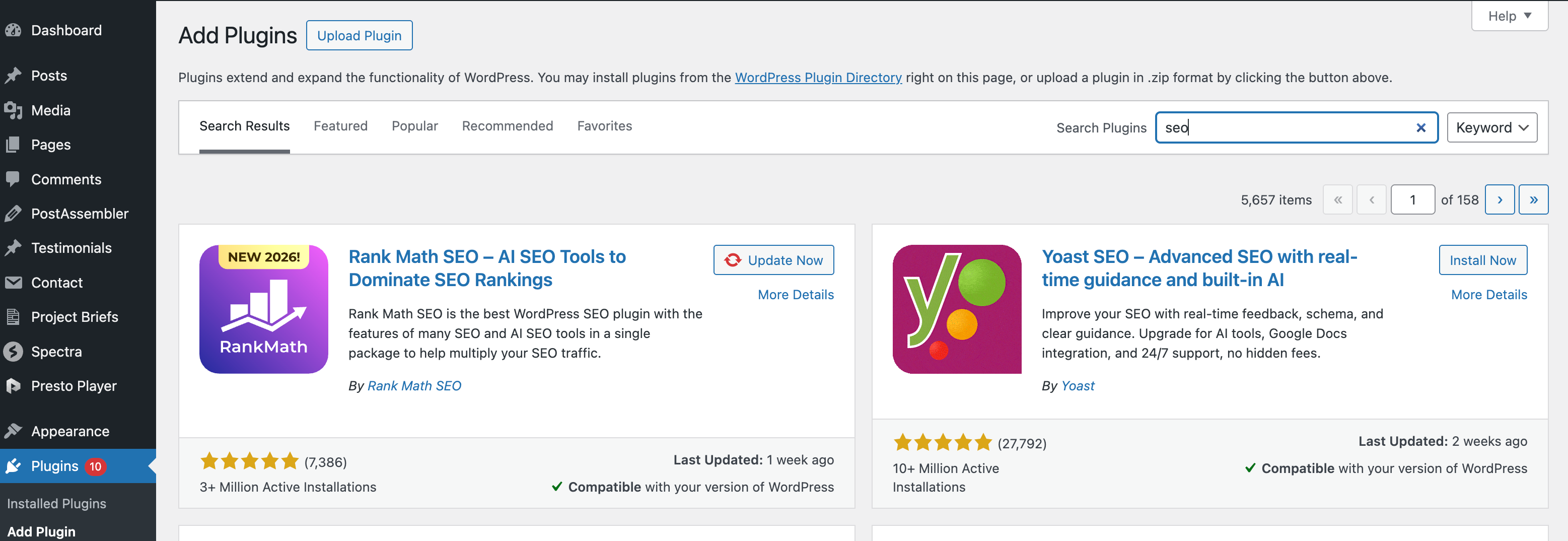
If you're on WordPress, you've probably heard of Yoast and RankMath. Whichever one you're more comfortable with, just pick one and commit. They each have their strengths and I'll get into those later.
To install one, go to:
Plugins > Add Plugin > Search for SEO or the specific plugin name. From there, install and activate it by following the prompts. These plugins are designed to be intuitive so don't overthink it.
Page SEO
Once your plugin is installed and activated, you now have the ability to optimize your SEO page by page. Congrats, you're dangerous now.
When you open a page in the editor and scroll down, you'll find a new set of settings from your plugin. Sometimes it shows up in the right sidebar. The plugin needs a focus keyword to start working, so find that input field and choose your keyword wisely.
Choosing the Right Keyword
Keyword selection is everything. Marketers use research tools to find the perfect keyword combinations that generate the results they're after. Every page has different needs depending on the subject, page type, and user intent.
Here are the tools people use:
- Keyword Planner — Free
- Keysearch — Paid
- Keyword Surfer Extension — Free
- Semrush — Paid
- Ahrefs — Paid
- Surfer - Paid
These tools help you analyze what people are searching for, the traffic those searches bring, and how competitive those keywords are. The golden rule is to target high volume, low competition — especially if your site doesn't have a lot of traffic yet. Search engines prioritize sites that already get traffic, so going after highly competitive keywords early is a losing battle.
How to Do Keyword Research Without Paying
Keyword Planner is free but Google will ask you to create an Ad account to access it. They'll prompt you to set up an ad and enter billing info. Before you close the tab — hear me out.
Create the ad, add your billing info, and let it run for a few seconds. Google needs time to approve ads before they actually show them to anyone, so you won't get charged. Once it's up, pause or cancel it immediately. You just finessed Google Ads and now you have access to their tools for free.
From there:
Tools & Settings > Keyword Planner > Discover New Keywords > Select language and location > Enter your keywords > Get Results
You'll see keyword suggestions with average monthly search volume and competition level. Your goal is to find keywords tied to your topic with high monthly searches and low competition.
What Paid Tools Offer
Paid tools like Keysearch give you a more fine-tuned approach to keyword research. Some of them actually have more up-to-date data than Google's own tools. The workflow is simple — pick one strong focus keyword and a few solid supporting keywords with ranking potential, then plug them into your SEO plugin.
Page Titles
Every page needs a title, but not just any title. It needs the RIGHT title.
Rules for page titles:
- The focus keyword must be included
- The focus keyword must appear in the first 4 words
Not good: AI Makes it Easy Starting SEO for Beginners
Good: SEO for Beginners is Easier with AI
- Use numbers and power words when you can
Strong example: 10 Rules of SEO for Beginners with AI
URLs
Your URL, also called a permalink, is the address someone types to reach your page. Keep it clean and make sure it includes your focus keyword.
Good: /seo-for-beginners
Bad: /seo-post-2
Meta Description
Every page needs a meta description to give search engines a reason to rank it. Bing recommends 150 to 160 characters. After 160, Google starts truncating your text. Write it in your SEO plugin, include your focus keyword, and make sure it clearly tells people what the page is about.
Writing Your Content
This is where it gets tricky. Some people write everything manually the old fashioned way. Others use page templates. Both have trade-offs.
Writing manually takes forever but it's safer. Page templating is genuinely dangerous. Most templates have zero variation — a few words changed while the rest of the page is identical to every other page on the site. This method worked in the early 2000s but got patched in 2024. In 2026, Google is actively de-indexing this content. I've personally seen sites with hundreds of pages where only 30 were indexed because of this. Google flags it as low-value or duplicate content and it doesn't go well.
Also avoid creating more than one page targeting the same keyword. That's a fast track to a duplicate content flag, potential de-indexing, and in the worst case a keyword stuffing violation. Once search engines start stacking negative marks on your site, it takes a long time to recover that authority.
However you generate content, make sure your focus keyword appears in the first 10% of the content — ideally in the first one or two lines.
How Long Should Your Content Be?
The bare minimum is 600 words. That's the floor for getting indexed. I've seen pages with less get indexed but it's a gamble I wouldn't take.
If you look at the top pages in the SERPs, most of them are writing 2,000 to 4,000 words. More content gives search engine crawlers more to work with and increases your value against competitors.
Keep paragraphs short — under 100 words. You want content that's easy to digest. Nobody came to your website to read a novel.
Title Tags
Title tags are your headings — the H2 through H6 tags in HTML. In site builders they might have different labels but the concept is the same. Use your supporting keywords and focus keyword in these headings. Some marketers use Chrome extensions like SEO Meta in 1 Click to quickly audit the heading structure on any page.
Images
Images are a ranking factor too. Make sure every image has a title, description, and most importantly alt text. Alt text is the text that appears when an image fails to load and it's what screen readers use for visually impaired users. It's also what crawlers read when they index your page. Relevant alt text proves your page's originality and value.
Keyword Density
Mention your focus keyword early and consistently throughout your content, but don't go past 5% keyword density. It's a balance — enough for the reader and the crawlers to recognize what the page is about, but not so much that it reads like spam.
Keyword stuffing is when you cram the keyword in so many times it destroys the quality of the page. Search engines have been hammering sites for this for years. Once you get that kind of violation, your entire site is at higher risk of being de-indexed and it can take months to recover. Don't try to game the system. Just follow best practices.
External Links
Links build credibility. When you link to external sources, make sure they're set to dofollow so crawlers can follow the link and award credit for it. This helps search engines track traffic flow and recognize that your page is connected to credible sources.
Internal Links
Internal links connect pages within your own site. Wikipedia is the GOAT example of this. Internal linking reduces bounce rate and strengthens the authority of both pages involved. A page that gets linked from an already-indexed page is far more likely to get indexed itself. These small moves stack up and build real site authority over time.
SEO in the Age of AI Overviews
Here's where things get real. The game has shifted and a lot of people haven't caught up yet.
Informational fluff is getting eaten alive. If you publish basic how-to guides, AI Overviews are already answering those queries before anyone clicks your link. To win here, write content that AI can easily digest and summarize. That way you can still pull some of that organic traffic back to your site.
Depth and specificity are non-negotiable now. Practical comparisons from personal experience, case studies, and local intent pages are where the real traffic opportunities are hiding.
Stop chasing generic commercial keywords. Nobody needs another article titled "How to Lose Weight." Write something like "best adjustable dumbbells under $300 for home weight loss" — specific, intentional, and actually useful.
What Actually Works Right Now
Target deeper content. Basic info posts get fewer clicks. Tutorials, case studies, comparisons, and personal experience pieces are winning.
Build topic authority. Write multiple related articles in one niche instead of scattered keyword posts. Become the destination, not just a result.
Optimize for AI summaries. Clear answers, structured headings, and accurate information increase your chances of being referenced by AI tools.
Add real human insight. Original opinions, personal examples, and genuine expertise matter more than ever. Generic content is getting buried.
Use AI for speed, edit for quality. Tools like WordHero help with drafts but human editing and unique value are what actually drive rankings.
Don't rely only on Google. Communities, social media, and email lists are becoming essential traffic sources alongside search.
The Mindset Shift
Stop writing for the query. Start writing for the next question.
AI Overviews handle the obvious answer. Your page needs to cover the follow-up, the edge cases, the tools, the examples, the checklist, the template, the comparison — the stuff AI can't wrap up in a three sentence summary.
Build pages that can be cited. Tight structure, clear definitions, quick takeaways, and sourced claims. You want Google to be able to pull a clean chunk from your page without having to guess what you meant.
Add something that can't be auto-summarized: original photos, screenshots, calculators, mini datasets, first-hand walkthroughs, or a real comparison table.
Go hard on internal linking and topic clusters. AI Overviews might steal the first click but strong clusters still win long term because you become the obvious destination in your niche.
Mix in queries with buyer intent and brand intent. AI Overviews hit hardest on informational content. Commercial and comparison pages still get real clicks.